
中

The wave of regenerative medicine is surging forward. Induced pluripotent stem cell therapy, with its immense application potential and a continuous stream of breakthrough achievements, is rapidly becoming the hottest field in the global medical sector.
Recently, exciting progress has been made in this cutting-edge field - not only has it opened up new paths for the treatment of intractable diseases, but it has also injected strong impetus into the development of regenerative medicine as a whole, making the hope of overcoming difficult diseases increasingly clear.
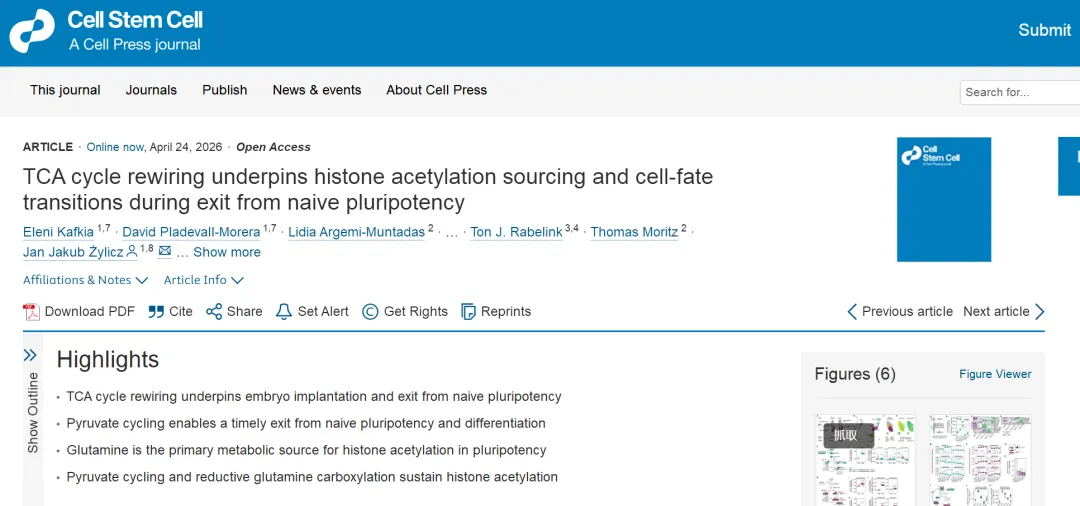
Cell Stem Cell | The tricarboxylic acid cycle regulates chromatin remodeling and determines the fate transformation of pluripotent stem cells
Recently, the international top journal "Cell Stem Cell" published online a groundbreaking study led by the Novo Nordisk Foundation Stem Cell Medicine Center (reNEW) at the University of Copenhagen.
The team systematically analyzed the dynamic reprogramming of the tricarboxylic acid cycle (TCA cycle) using multi-omics technologies. They played a crucial regulatory role in the process where embryonic stem cells exit pluripotency and complete their fate transformation. For the first time, they completely constructed a coupled regulatory framework of "metabolism - chromatin - cell fate", providing new theoretical support for stem cell differentiation regulation, regenerative medicine applications, and disease mechanism research.
For a long time, the academic community has focused on the decisive role of transcription factor regulatory networks in determining cell fate, but has still not been able to fully answer the question: How exactly do the metabolic activities within cells, at the molecular level, link the remodeling of chromatin states, ultimately driving the irreversible transformation of cell fate?
The research team used the transformation of mouse embryonic stem cells (ESC) into EpiLC as the core model. They integrated multiple-dimensional technologies such as ¹³C stable isotope tracing metabolomics, transcriptome sequencing, and quantitative analysis of post-translational modifications of histones. At the same time, they constructed an IDH1-induced degradation system to precisely track the dynamic changes of the TCA cycle, the distribution rules of carbon flow, and its regulatory effects on epigenetics and cell fate during the process of stem cells losing pluripotency.
01 IDH1: The core regulatory node that connects cytoplasmic and mitochondrial metabolism
Isocitrate dehydrogenase 1 (IDH1) is the core target molecule that was identified in this study. As a key molecule that connects the cytoplasmic and mitochondrial metabolic networks, the completeness of IDH1's function directly determines the direction of carbon flow distribution within the cell.
The research found that when the IDH1 protein was induced to degrade, the carbon flow metabolism within the stem cells was significantly disrupted, directly resulting in a severe limitation in the production of acetyl coenzyme A. Acetyl coenzyme A is the core substrate for histone acetylation modification, and its insufficient supply would cause a decline in the histone acetylation level across the entire genome, directly altering the open state of chromatin - genes that maintain pluripotency cannot be normally transcribed, and the orderly initiation of differentiation-related gene programs is also impossible. Eventually, the process of stem cells losing their pluripotency is completely blocked.
02 Dual metabolic pathways collaborate: The core metabolic network for maintaining stem cell pluripotency
The research team further clarified the metabolic basis for the maintenance of epigenetic plasticity in pluripotent stem cells: In the original pluripotent stem cells, the reductive carboxylation pathway of glutamine metabolism forms an efficient synergistic metabolic network with the pyruvate cycle.
The synergy of these two metabolic pathways provides the core support for the continuous and stable supply of acetyl coenzyme A within the cell. This metabolic system maintains the high level of histone acetylation, open chromatin conformation, and stable expression of pluripotency genes within stem cells. Once this coordinated network is disrupted, the epigenetic plasticity of stem cells will sharply decline. Not only will they fail to complete the process of pluripotency exit normally, but they will also exhibit problems such as deviation in the differentiation program and abnormal cell fate.
Reduced glutamine carboxylation collaborates with the pyruvate cycle to maintain stable levels of histone acetylation
03 For the first time, a complete coupling regulatory framework of "metabolism - chromatin - cell fate" has been constructed.
Based on comprehensive experimental evidence, the research team has proposed a brand-new theory on cell fate regulation: the reprogramming of metabolic flux is the upstream core event that drives the transformation of stem cell fate.
The complete regulatory logic is:
Reprogramming of metabolic pathways related to the TCA cycle → Changes in the intracellular supply level of key metabolites (acetyl-CoA) → Remodeling of the global histone modification landscape → Global changes in chromatin open state → Reconstruction of the gene expression network for maintaining pluripotency and initiating differentiation → Irreversible transformation of cell fate.
This framework has completely broken through the entire chain of "metabolic regulation - epigenetics - gene expression - cell fate", proving that metabolic reprogramming is not a by-product of the transformation of cell fate, but rather a core regulator that determines the direction of stem cell fate.
The pyruvate cycle can enable cells to promptly enter the pluripotent state of the developmental stage and undergo differentiation.
Summary
With the continuous deepening of research in the interdisciplinary field of metabolomics and epigenetics, the academic community has continuously deepened its understanding of the core regulatory network and molecular mechanisms of cellular life activities. This research further confirms that cellular metabolism is not an auxiliary downstream link in cellular life activities, but rather a core upstream regulatory hub that controls the process of cell fate determination. In the future, with the continuous improvement of the systematic understanding of the regulatory mechanisms of metabolic epigenetics, it is expected to achieve precise and targeted regulation of stem cell fate, bringing a key breakthrough to the innovative development of regenerative medicine and the protection of human health.