
中

Source: Health News
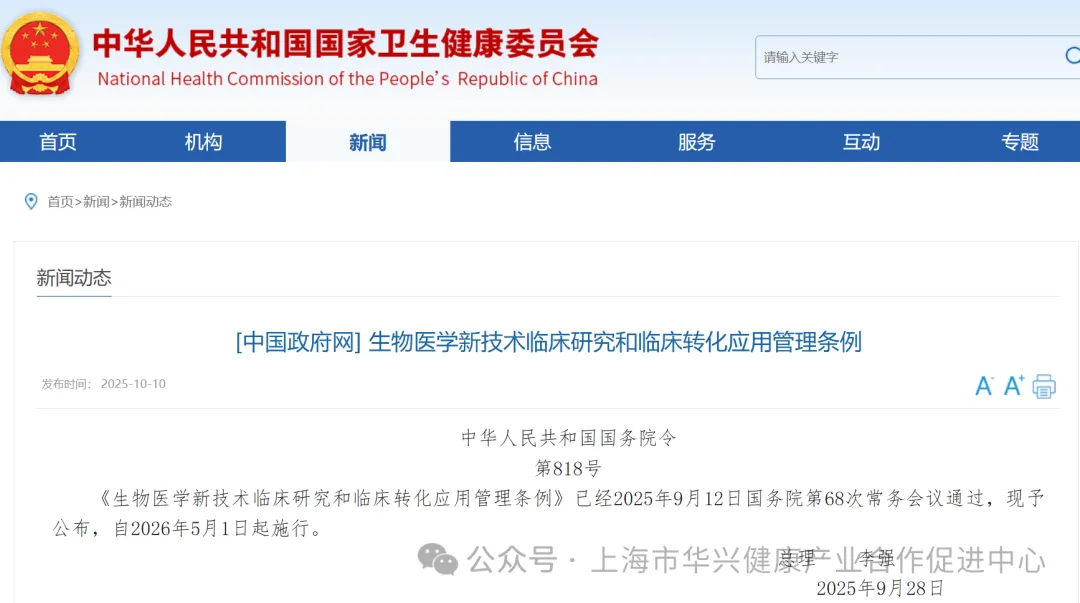
The "Regulations on Clinical Research and Clinical Transformation Application of Biomedical New Technologies" has been fully implemented since May 1st of this year. This is the first time that China has formulated such regulations in the form of administrative laws to systematically standardize biomedical new technology clinical research and transformation application. How to accurately grasp the core essence of the "Regulations" and ensure their effective implementation? Recently, Health News reporters conducted an interview with the heads of relevant departments and institutions such as the Education and Science Department of the National Health Commission and the China Biotechnology Development Center.
What significance does the promulgation and implementation of this regulation hold?
Biomedical new technologies have great potential in disease prevention, diagnosis and treatment. The state attaches great importance to the innovation and development of biomedical new technologies. In recent years, China's biomedical innovation capabilities have continued to improve, and new technologies have rapidly evolved. At the same time, these technologies act at the cellular and molecular levels and have practical problems such as high technical barriers and the lack of comprehensive disclosure of long-term risks. Therefore, it is necessary to coordinate development and security.
The regulation adheres to the principle of "putting people's health at the center", prioritizing the promotion of technological progress, ensuring medical safety and quality, and safeguarding people's lives and health. It has opened up a clear and risk-controllable compliant path for the clinical application of new technologies, marking that the regulation of biomedical new technologies in China has entered a new stage of legalization. This has a profound impact on promoting the high-quality development of the health care industry and the biomedicine industry.
What is the relationship between this regulation and the current systems for managing drugs and medical devices?
Our country has established a complete management system for pharmaceutical and medical device products, and the management system is in close alignment with international standards. With the advancement of technology, some cutting-edge technologies that are highly innovative, highly personalized, and difficult to standardize cannot fully meet the requirements of traditional drug and device review and approval. The clinical research and clinical application pathways for these technologies urgently need to be unblocked.
Article 55 of the Regulations clearly stipulates that for conducting clinical trials for the development of drugs and medical devices, the current laws and regulations shall be followed. Therefore, the Regulations do not replace or weaken the existing management model; instead, they open an independent management channel for cutting-edge technologies that are not covered by the product path. This "displaced development" design enables the new technology management system and the drug and medical device management system to complement each other's functions, jointly building a management system that covers the entire chain of biomedical innovation.
For clinical research institutions, this might present them with a choice: should they follow the path of new technologies, or the path of pharmaceuticals and medical devices?
The National Health Commission and the National Medical Products Administration jointly formulated the "Guidelines for the Definition of Biomedical New Technologies and Drugs and Medical Devices (Temporary)" and the "List of Pre-Approval Guidance for Biomedical New Technologies (First Edition)". In principle, for technologies with high individualization and rare disease fields where no drugs have been approved yet or confirmatory clinical trials have not been conducted (generally referring to Phase III clinical trials), the new technology path can be taken. During the early stage of clinical research, when there is considerable uncertainty about which path to follow, the initiating institution can independently define the attributes by referring to the "Pre-Approval Guidance List". In the clinical transformation and application stage, there are clear boundaries between new technologies and drugs and medical devices. The initiating institution must strictly abide by these rules.
To achieve clinical application, two points need to be noted: First, the clinical research data defined as a technical path should be used to support the technical transformation application; second, the technical path is not a transitional stage of the product path. The two are relatively independent and should not be misunderstood as a sequential substitution relationship. Clinical research involves patient rights and also consumes a lot of time and funds. Institutions should make cautious decisions and carefully select.
What are the conditions and standards for the clinical application approval of new biomedical technologies?
The "Regulations for the Approval of Clinical Transformation and Application of Biomedical New Technologies (Trial)" stipulates that for the application of new technologies for clinical transformation and application, in addition to meeting the requirements of safety, effectiveness, and compliance with ethical principles, it is also necessary to "during the clinical research stage, through multi-center participation, independently implement this technology in accordance with the clinical application operation norms, and obtain consistent conclusions on safety and effectiveness."
Medical technology is not exclusive. The approval of new technologies is an acknowledgement of the technology's maturity, rather than granting an exclusive right to the applying institution to use it. The requirement for multiple centers to participate in the process is to reduce single-center bias and enhance the reliability of the results; the requirement for independent implementation of the technology is to verify the completeness and operability of the operation procedures, and to ensure the technology's maturity, stability, and repeatability. After a new technology is approved for clinical application, all the units involved in the clinical research can carry out the research.
What are the key points to consider when initiating confirmatory clinical studies aimed at clinical application by the initiating institutions and research institutions?
Biotechnology confirmatory clinical studies are designed to provide evidence for the safety and efficacy of new technologies, and they are also a necessary step for subsequent applications for clinical use. Recently, the Biotechnology Center has drafted the "Technical Guidelines for Confirmatory Clinical Studies of Biomedical New Technologies", and is now soliciting public opinions. The formulation of these guidelines fully takes into account the characteristics of different technology types, the size of the patient population for indications, and also considers the safety, standardization and adaptability of new technologies. In general, confirmatory clinical studies have higher requirements than exploratory clinical studies, and they involve greater time and economic costs. It is particularly emphasized that for those who plan to conduct clinical transformation and application through a technical path, the initiating institutions and clinical research institutions must conduct thorough论证 before conducting confirmatory clinical studies, and strengthen communication and coordination with the Biotechnology Center regarding the design of the research plan.
The treatment of rare diseases is an important scenario for the application of new technologies. How should the scope of this be defined?
Currently, there is no unified definition of rare diseases worldwide. When applicants conduct confirmatory clinical research or apply for clinical translational applications, they can provide epidemiological data on the target diseases or scientific evidence confirming that the diseases are rare to professional institutions, so that the review experts can make judgments and grasp the situation during the review process. The national health commission's published rare disease directory, the "2021 Report on the Definition of Rare Diseases in China", the authoritative database Orphanet of rare diseases and orphan drugs in Europe, as well as the international classification and coding for rare diseases being promoted by the World Health Organization can all be used as references. The review process will ensure scientific rigor while also demonstrating care and support for the rare disease patient group.
How does the regulation prevent and control the risks associated with new technologies?
The regulation sets safeguarding medical quality and safety, as well as protecting human dignity and health, as its fundamental purpose, and integrates this into the entire management process.
Before conducting clinical research, it is necessary to prove through non-clinical studies that the technology is safe and effective. It is prohibited to carry out clinical research on technologies that are explicitly banned by the state, those for which non-clinical studies have not proven safety and effectiveness, or those with significant ethical issues.
During the clinical research stage, a comprehensive system for safeguarding the rights and interests of participants should be established throughout the entire process: strict informed consent; clear provisions for damage compensation and liability assumption; encouragement to purchase commercial insurance; strengthened protection of personal privacy; and implementation of long-term follow-up.
During the clinical application and transformation stage, risk classification management is implemented. The risk level is determined based on factors such as the complexity of the operation, the reversibility of the impact, and ethics. Different levels correspond to different approval procedures and restriction periods - high risk for 5 years, medium risk for 3 years, and low risk for only use by the original research institution within 1 year. After the expiration, it can be promoted in accordance with the registration of restricted medical technologies, and the clinical application situation can be reported case by case. In case of serious adverse reactions or medical accidents, they must be dealt with promptly and reported.
How does the "Regulation" achieve scientific governance through dynamic regulation?
Biomedical new technologies are characterized by rapid iteration, diverse types, and significant differences in maturity. The "Regulations" have established a full-chain dynamic adjustment mechanism covering clinical research registration, transformation and application approval, and post-approval application, forming a governance closed loop of "research - transformation - restricted period observation - continuous re-evaluation".
In the clinical research field, the "Registration Guidance List" adopts a two-way dynamic management approach: institutions can submit suggestions for the inclusion of cutting-edge technologies at any time, which will be included after expert review; technologies that are explicitly prohibited, have significant ethical issues, have questionable safety, or have already had similar products on the market will be promptly removed.
In the application transformation process, the technical and medical device paths are separated from the review and approval process of drugs and medical devices. Once similar drugs are approved for market launch or enter confirmatory clinical trials, the technical management attributes will be redefined, guiding the research and development direction to orderly exit or shift.
After the application is approved, a dynamic supervision system of "periodic observation + continuous re-evaluation + withdrawal for non-compliance" will be implemented. In case of severe adverse reactions or significant changes in safety and efficacy, re-evaluation will be initiated immediately and the application will be suspended. For those that fail the assessment, clinical application will be prohibited. This "in-and-out, dynamic calibration" closed-loop management is a crucial step in enhancing the modernization level of governance in the biomedical field.
Have the pilot areas that previously carried out trials of new biomedical technologies been granted special policies after the implementation of the "Regulations"?
The pilot projects of cell and gene therapy and other technologies that were previously carried out in places such as Boao Lecheng International Medical Tourism Pilot Zone in Hainan Province, Beidaihe District of Qinhuangdao City in Hebei Province, Nansha District of Guangzhou City in Guangdong Province, Chengdu City of Sichuan Province, and Changsha City of Hunan Province have made practical preparations for legislation. After the implementation of the Regulations, except for those areas where the application is specially authorized by the State Council, all regions including the previous pilot areas must strictly abide by the Regulations. Each pilot area should complete the policy coordination as required, properly handle the new technologies that were approved or filed for clinical application based on the original pilot policies in the past in accordance with the law and regulations, and shall not approve or file for the clinical application of new biomedical technologies based on the original pilot policies again.
What measures will be taken next to ensure the implementation and effectiveness of the Regulations?
The vitality of a system lies in its implementation. In the next step, we will focus on carrying out work in five key areas.
First, strengthen technical support and supervision enforcement. All levels of health administrative departments must regard the implementation of the "Regulations" as a key task, refine the task list, and organize professional forces to enhance technical guidance; utilize information systems to implement precise supervision, establish a regular supervision mechanism, open up complaint and reporting channels, and strictly handle illegal and irregular behaviors in accordance with the law.
Second, it is necessary to strengthen the primary responsibility of the institutions. The institutions initiating clinical research and the clinical research institutions are the first responsible entities. They must strictly follow the filing and approval procedures, establish internal management systems, and be equipped with personnel for ethical review, quality management, risk monitoring, etc. They should scientifically select research paths and fulfill the obligations of data reporting and reporting of adverse events.
Thirdly, strengthen the functions of professional support institutions. Professional institutions should strictly control the quality of registration verification, transformation assessment and re-assessment, keep up with the latest technologies, improve the construction of the expert database, and ensure the connection of review and re-assessment standards and mutual recognition of results. Fourthly, enhance publicity, training and public opinion guidance. All levels of health administrative departments should incorporate the "Regulations" into theoretical learning content, accurately interpret practical issues for research institutions and enterprises, promptly respond to concerns, and provide positive guidance. Fifthly, focus on information sharing and experience exchange. All levels of health administrative departments need to strengthen coordination with departments such as science and technology, drug supervision, etc., establish and improve cross-departmental collaborative mechanisms, promote the interconnection of regulatory information, and ensure that all regions are in step and have unified standards.
The promulgation and implementation of the "Regulations" have ushered in a new stage of standardized, legalized and scientific management of new biomedical technologies in our country. The National Health Commission and its professional institutions (Biological Center, Medical Management Center) will continue to strengthen capacity building and improve the professional level of evaluating biomedical new technologies. With a high sense of political responsibility and historical mission, they will make new and greater contributions to building a healthy China, promoting the development of the biomedicine industry, and enhancing the health benefits of the people.