
中

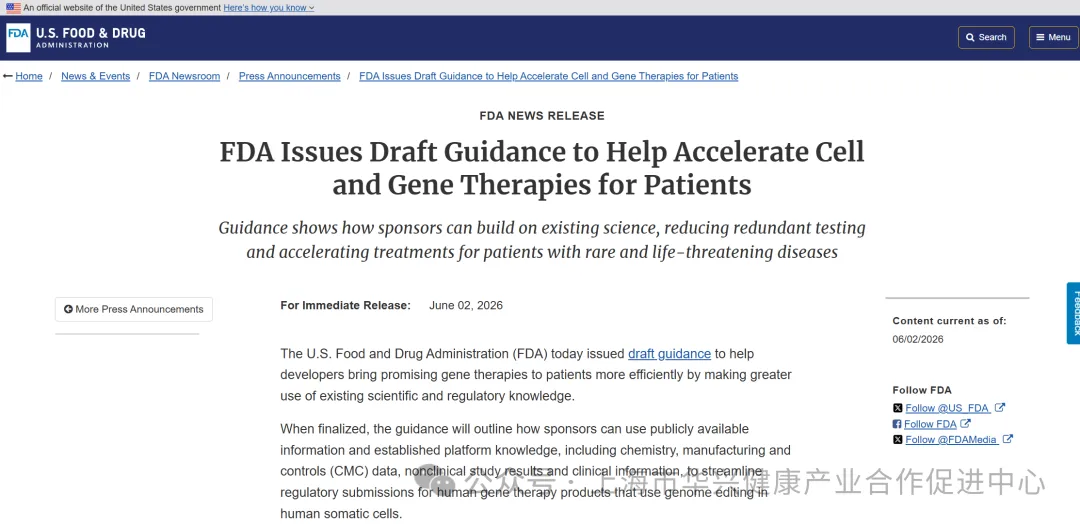
On June 2, 2026, the US FDA officially released a brand-new draft guideline on cell and gene therapies - "Developing Human Gene Therapy Products Involving Genome Editing Using Pre-existing Knowledge", which has delineated a clearer and more efficient path for the development and registration of cell and gene therapies (CGT) and especially genome editing products in this field.
This is the key action taken by the FDA in the field of CGT regulation this year. The core objective is to enable developers to fully leverage the existing scientific evidence and platform experience, reducing redundant experiments and tests, and ultimately accelerating the process of bringing innovative treatments for rare diseases and life-threatening conditions to market.
Core idea: Replace repetitive verification with "existing knowledge"
Once the final version of this guideline is completed, it will clearly state that the sponsors can utilize two types of existing information to simplify the regulatory submission materials for gene therapy products:
Publicly accessible industry-standard scientific data; platform-level knowledge accumulated by the enterprise's own mature technology platform, covering three core modules: chemical, manufacturing and control (CMC) data, non-clinical research results, and clinical research information.
This approach directly addresses the long-standing pain points in the CGT industry: In the product development of similar technology platforms, a large amount of basic verification work is repeatedly carried out, which not only raises the R&D costs but also slows down the pace at which patients can access new drugs. The FDA's adoption of this guideline to clearly define the compliant path for data reuse essentially aims to "unbuckle and accelerate" the R&D process within the regulatory framework.
Coordinating genomic editing products with the existing regulatory framework
This draft focuses on supporting various cell and gene therapy products, including genome editing technology. It is the latest piece in the FDA's effort to complete the regulatory puzzle for CGT:
It supplements the regulatory framework for genome editing therapies, providing enterprises with practical scientific tools and data-sharing strategies, and helping developers efficiently establish the evidence system for their products.
It complements the draft "Assessment of the Safety of Genome Editing in Human Gene Therapy Products Using Next-Generation Sequencing" previously released by the FDA - the former clearly defines the assessment methods for off-target risks, while this guideline explicitly clarifies the rules for data reuse throughout the development process. Together, they form a more comprehensive regulatory guideline for genome editing therapies.
The FDA also emphasized that the improvement in efficiency must not come at the expense of safety. The guidelines always adhere to strict safety standards for patients as the bottom line, and all data reuse must be based on scientific and verifiable foundations.
Submission Key Reminder: Two Core Requirements
The guideline also sets out clear compliance requirements for the sponsors. Enterprises must not simply copy the data without conducting an adaptability assessment:
It is necessary to prove the applicability of the data: Whether using publicly available data or historical data from the platform, the sponsor needs to provide sufficient scientific evidence to demonstrate the applicability of this data to their specific product and specific development scenario. It cannot be directly generalized.
It is recommended to conduct early alignment communication: The FDA encourages companies to communicate their specific development strategies with the regulatory authorities through official channels such as INTERACT (the preliminary directional participation of product regulatory suggestions) and pre-IND meetings before the development stage (even before submitting the IND application), in order to align their understanding in advance and reduce the risks associated with subsequent submissions.
This draft guideline is currently in the stage of public consultation. Once finalized, it will provide a clear and science-based path for developers in the field of cell and gene therapy, enabling them to fully utilize existing knowledge and experience while maintaining strict standards to ensure patient safety.