
中

Recently, the China Biotechnology Development Center released the "Guidelines for Clinical Research of New Technologies in Tissue Stem Cell Therapy (Version 1)", which will come into effect on May 1, 2026. It is a technical document in support of the "Regulations on Clinical Research and Clinical Transformation and Application of Biomedical New Technologies" issued by the State Council (Order No. 818).
This guideline fills the regulatory gap for the clinical research of non-drug-related stem cells, clearly distinguishing between the "drug registration path" and the "technical filing path", and providing unified and operational technical standards for stem cell clinical research led by medical institutions. It addresses the issues of inconsistent regulatory standards and ambiguous filing procedures across different regions.

1. Scope of Application and Boundary Definition
Applicable scope: Clinical research on new stem cell treatment technologies conducted within China, not for the purpose of drug registration.
Clear definition: The new technology of tissue stem cell therapy refers to "the technique of using specific tissue stem cells from the patient's own body or from a donor, conducting operations at the cellular and genetic levels outside the body, and then reinfusing/implanting them back into the human body."
Exclusion criteria: Clinical trials of stem cell products for the purpose of drug registration shall still be conducted in accordance with the "Guidelines for Registration and Review of Cell Therapy Products" issued by the National Medical Products Administration.
2. The three-level responsibility entities and qualification thresholds
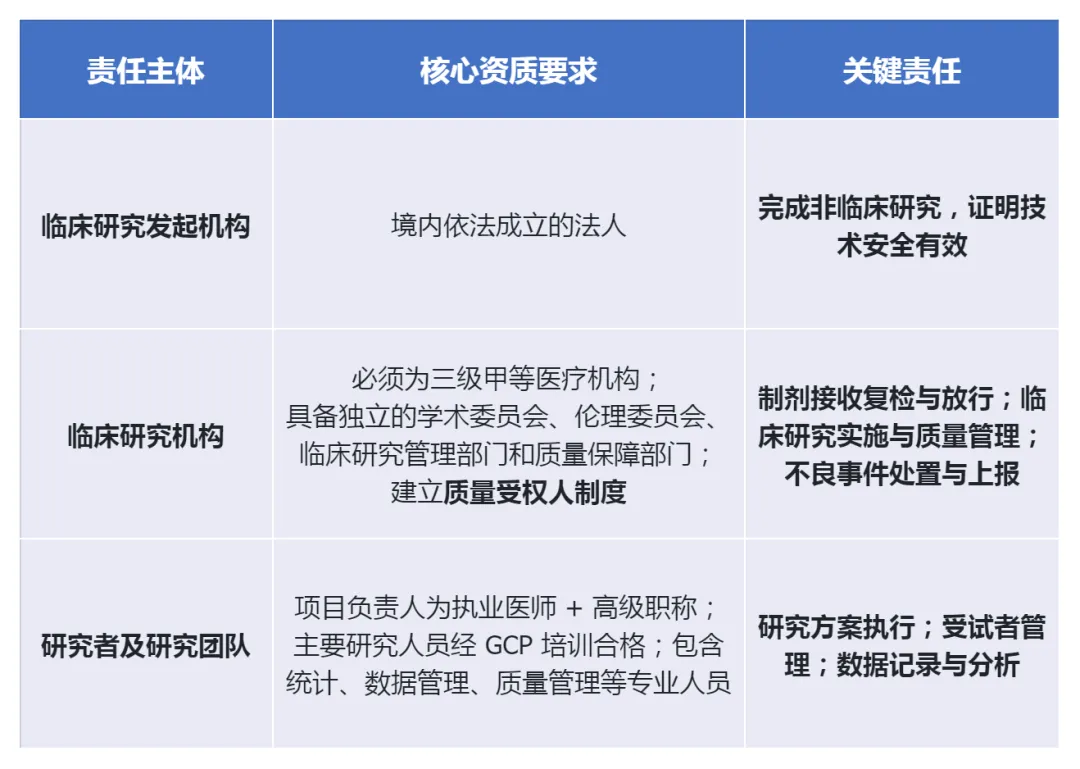
Highlights: For the first time, a quality authority system for clinical research institutions has been clearly defined. It requires that the personnel holding this position possess a senior professional title and at least 3 years of experience in quality management of stem cell preparations, and be solely responsible for the release of the preparations, thereby strengthening the primary quality responsibility of clinical institutions.
3. Formulation Preparation and Quality Control
This part is the most crucial aspect of the filing review process, and the core requirements include:
GMP principles are fully covered: Even if the clinical institution prepares the preparations by itself, it must follow the relevant GMP principles; for those prepared through external cooperation, a comprehensive assessment of the partner's qualifications, facilities and quality system is required.
Donor screening and classification management:
Allogeneic donors: Mandatory screening for HIV, HBV, HCV, syphilis. Samples rich in white blood cells should also include HTLV, CMV, and EBV.
Autologous donors: The requirements for excluding infectious diseases can be appropriately relaxed, but the risk of cross-contamination must be evaluated and preventive measures should be taken.
Risk management of raw materials and auxiliary materials:
First, use materials of medicinal grade; for materials that are not of medicinal grade, a risk assessment is required.
Prohibition of the use of penicillin and other β-lactam antibiotics
Try to avoid animal-derived materials and strictly prohibit the use of animal sera from epidemic areas.
Flexible management of cell banks:
Long-term amplification, genetic modification, and cloning screening preparations must establish cell banks.
Self-contained, short-cycle, and low-operation preparations do not need to be stored in a library, but measures such as sample retention of raw materials and control of the maximum number of passages are required to ensure traceability.
Special requirements for genetically modified cells: Focus on controlling the risk of off-target editing, the amount of vector residue, and the risk of replication-type virus revertant mutations; Cells modified with lentivirus / γ-retrovirus need special detection of replication-type viruses.
Mandatory third-party re-inspection: Before the clinical study is initiated, the key safety indicators such as sterility, mycoplasma, endotoxin, and exogenous viruses of the cell bank and final formulation must be re-evaluated by a qualified third-party institution and a re-inspection report must be provided.
4. Non-clinical research requirements
Test substance consistency: The formulation used in non-clinical studies must be exactly the same as the formulation intended for clinical use in terms of preparation process and quality standards.
Animal model relevance: Prioritize the selection of animal models that can simulate the progression of human diseases. Immune-deficient animals are used for human cell implantation research. In necessary cases, combined use of large animals and organoid technology is also considered.
Key points of safety assessment:
Tumorigenicity / Carcinogenicity: Reports can be submitted in stages. At least in vitro tumorigenicity tests should be completed before the clinical study, and a complete set of in vivo test reports should be submitted during the confirmation stage.
Immunogenicity and immunotoxicity: Evaluation through combination of in vitro and in vivo tests
Long-term toxicity: Multiple autopsy time points and recovery periods were set to observe delayed toxicity.
Cellular metabolic kinetics: It is necessary to track the distribution, migration, colonization, survival and differentiation processes of cells within the body.
5. Clinical research and long-term follow-up
Research stage division: It is divided into exploratory clinical research (for initial safety and efficacy) and confirmatory clinical research (for large-sample validation)
Follow-up requirements (mandatory):
Normal unmodified cells: Follow-up period of at least 2 years
Genetic modification, long-term survival or high-risk cells: Follow-up period of at least 5 years
Child participants: Pay extra attention to the effects on growth and development, neurocognition, and the reproductive system, and appropriately extend the follow-up period.
Risk management: For high-risk research, a data safety monitoring board (DSMB) should be established; clearly define four legal circumstances for study suspension / termination; in case of serious adverse reactions, the study should be immediately suspended.
Attached file