
中

On May 13th, the Central Social Insurance and Medical Agreement Committee of the Ministry of Health, Labour and Welfare of Japan officially approved the inclusion of two iPS cell drugs in the national medical insurance scheme, which will come into effect on May 20th.
Among them, Amchepry, jointly developed by Sumitomo Pharmaceutical and Racthera, is the world's first drug derived from iPS cells for the treatment of Parkinson's disease. The price for a single dose is 55,306,737 yen (approximately 2.38 million yuan).
The core mechanism of Amchepry is to differentiate induced pluripotent stem cells (iPS cells) into dopamine neural precursor cells, and then transplant them into the patient's brain through surgery. This way, the damaged dopamine-based nervous system can be repaired, and neural functions can be restored. This technical approach directly targets the pathological root of Parkinson's disease - the progressive degeneration of dopamine-based neurons in the substantia nigra of the midbrain. It provides a new treatment option for patients for whom traditional drugs are ineffective in controlling the condition.

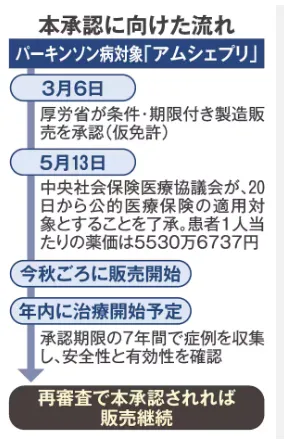
In March 2026, the Ministry of Health, Labour and Welfare of Japan approved the production and sale of Amchepry with conditions attached and within a time limit. The approval period is 7 years. During this period, clinical data must be continuously collected to verify its long-term safety and efficacy. If the subsequent review confirms the efficacy, it will be converted to an unconditional formal approval.
Key time points:
March 6, 2026: The Ministry of Health, Labour and Welfare approved conditional and time-limited production and sales (temporary license)
May 13, 2026: The Central Social Insurance and Medical Care Agreement Committee approved inclusion in the medical insurance scheme, which will come into effect on May 20.
Autumn 2026: Sales commence as planned
By 2026: Commence clinical treatment
Clinical trials will be conducted on 30 patients aged 18 to 65 at 7 institutions. Subsequently, 5 patients over 65 years old will be transplanted. The scope of institutions and patients will be gradually expanded in the future.
The data from the Phase I/II clinical study published in the top international journal "Nature" previously showed encouraging results:
During the 24-month follow-up period, the transplanted cells were able to survive in the patients' brains for a long time and continuously secrete dopamine. Among the 4 evaluable patients, the average "off period" MDS-UPDRS-Ⅲ score improved by 9.5 points (an increase of 20.4%), and the motor symptoms were significantly improved. This data provides important clinical evidence for the application of iPS cell therapy in neurodegenerative diseases.
Since Amchepry is a globally pioneering product and there are no comparable drugs for reference, the pricing is calculated based on the original price.
Under the Japanese high medical care fee system (the major illness medical insurance mechanism), the patient's out-of-pocket contribution rate is generally 30%, but there are strict monthly and annual upper limits on the out-of-pocket expenses:
Take patients with an annual income of approximately 3.7 million - 7.7 million yen (about 170,000 - 350,000 yuan) as an example. The annual individual actual burden limit is approximately 530,000 yen (about 24,000 yuan). This system design significantly lowers the economic threshold for patients, enabling innovative treatments to truly benefit ordinary patients.